In October 2026, a team from the UK Atomic Energy Authority (UKAEA) visited ENN Fusion to carry out a joint experimental campaign on EXL-50U, ENN Fusion’s spherical tokamak for proton–boron fusion research.
The campaign was conducted under the International Tokamak Physics and Engineering Activity (ITPEA), a collaborative activity associated with the International Thermonuclear Experimental Reactor (ITER).

The experiments focused on two key areas of tokamak physics. The first investigated the effects of electron cyclotron (EC) heating on the evolution of the safety-factor (q) profile and the onset and development of magnetohydrodynamic (MHD) instabilities, providing insights relevant to future operation at higher plasma parameters. The second examined the power threshold for electron cyclotron wave (ECW) pre-ionization and the factors that influence it, with a particular focus on how initial plasma conditions affect inductive tokamak start-up.
Over more than ten days of close collaboration, the two teams completed all planned experiments, collected key diagnostic data and conducted preliminary analyses. The work advanced their understanding of MHD behaviour and added to the experimental database on pre-ionization and start-up in tokamaks with different aspect ratios. It also shed further light on how plasma parameters evolve during start-up and the physical mechanisms underlying these processes.
The experimental campaign was accompanied by extensive technical discussions covering EXL-50U experimental results, progress on the construction of EHL-2 facility, experimental results from the MAST Upgrade (MAST-U) spherical tokamak, and operational experience from the Joint European Torus (JET).
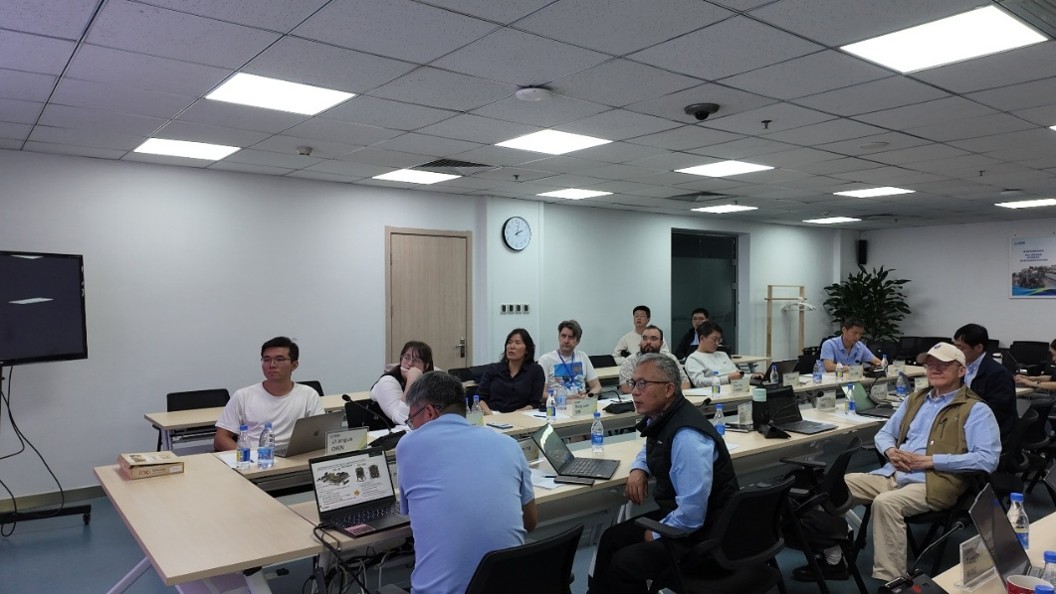
Damian King, a senior experimental operations specialist at UKAEA, said: “The experiment here was very well suited as a comparison to our own machines. It could produce a lot of very useful data on spherical tokamak physics”.
Charles Vincent, a plasma control system engineer at UKAEA, said: “The purpose of this experiment is to add to this electron cyclotron pre-ionization database. ITER, which is an important international collaboration and which is what the ITPEA focuses on, is expected to need this pre-heating to help the plasma start up. Taking the data has been very easy here. The team here is great. They’ve been very helpful. I think this is a good example of international collaboration”.
Sam Blackmore, a senior diagnostic physicist at UKAEA, thanked the ENN Fusion team for its support and expressed her hope that the two teams would continue to strengthen their collaboration and exchange of expertise in the future.
The campaign marks the first time an international fusion team has conducted on-site experiments at ENN Fusion since the company joined ITPEA this April. ENN Fusion will continue to make its experimental facilities available to research partners around the world, fostering international collaboration to tackle key challenges in fusion science and accelerate progress towards fusion energy.
About UKAEA:
The UK Atomic Energy Authority (UKAEA) is a UK government research organisation established in 1954. Originally responsible for Britain's early nuclear programme, it is now tasked with the research and delivery of sustainable fusion energy. UKAEA operates the MAST-Upgrade fusion machine, leads the STEP programme to demonstrate net energy from fusion, and is transitioning JET from plasma operations to repurposing and decommissioning. It also engages in the Fusion Futures programme, which drives innovation and industry capacity through international collaboration. The organisation employs approximately 2,600 people across its sites in Culham, West Burton, Cumbria, and South Yorkshire.
UKAEA and ENN Fusion Conduct Joint Experiments under ITPEA on EXL-50U
2026-10-26ENN Fusion Achieves Experimental Demonstration of Proton–Boron Fusion on the EXL-50U Spherical Torus
2026-09-21Global Experts Gather in Langfang for ISPBF 2026
2026-07-24ENN Fusion Secures Pre-A Financing Round at RMB 10.6 Billion Post-Money Valuation
2026-07-13