September 2026 — ENN Fusion achieved a major milestone in its pursuit of commercial proton–boron fusion energy. The company’s EXL-50U experiment recorded evidence of proton–boron (p–¹¹B) fusion reactions.
The privately owned company ENN Fusion operates the fusion experiment and focuses on achieving clean, aneutronic fusion using hydrogen and boron-11.
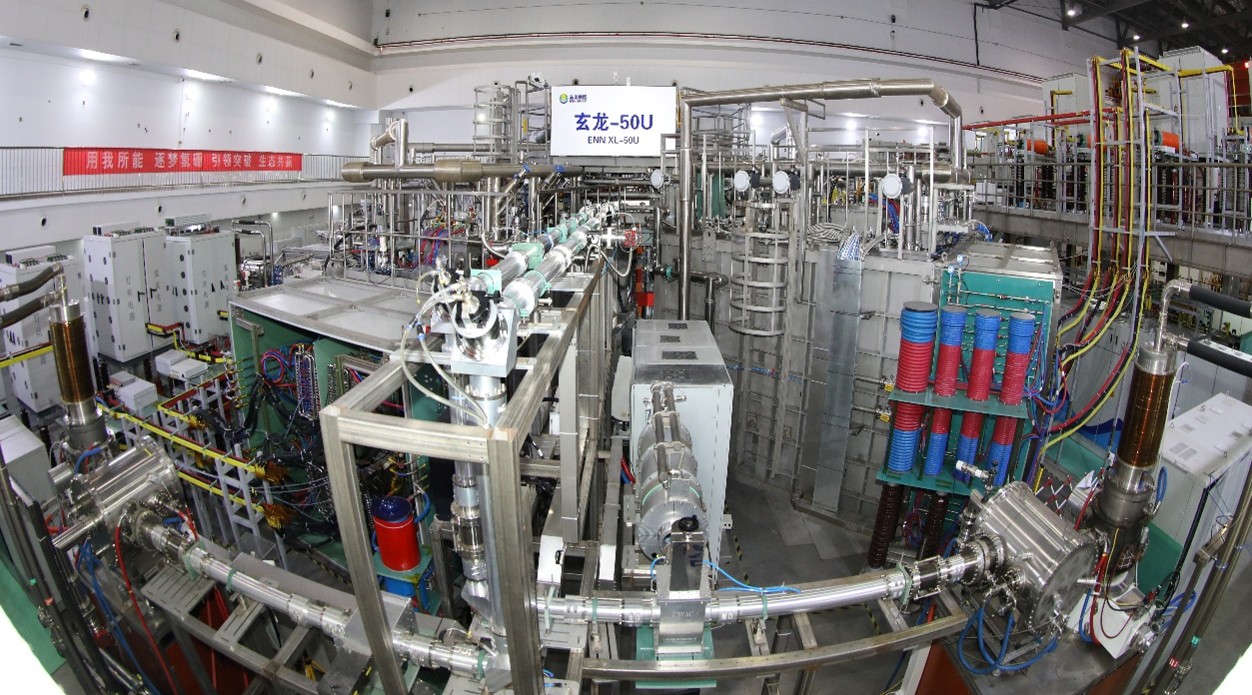
ENN’s EXL-50U Spherical Torus
Proton–boron fusion produces energetic alpha particles, negligible neutron production, abundant and readily available fuel, and the potential to convert ion energies into electricity. However, p–¹¹B fusion faces the challenges of requiring substantially higher plasma temperatures and confinement conditions than deuterium–tritium (D–T) fusion.
This challenge stems from the double-peaked energy dependence of the p-¹¹B fusion cross section: a sharper lower peak near 160 keV and a higher, broader peak centered near 675 keV.
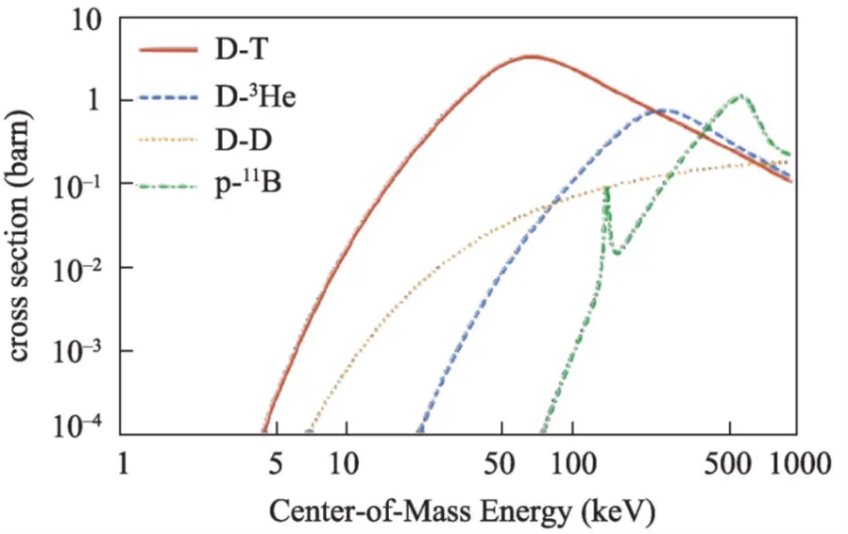
Cross Sections of Common Fusion Reactions
To address these challenges, the ENN Fusion team has combined high-energy neutral beam injection (NBI) with radio-frequency (RF) or millimeter electron cyclotron resonance wave heating to enhance the population of energetic, non-thermal protons near the first resonance peak of the p–¹¹B reaction. The SiC sensors recorded an estimated 350 alphas with energies ranging from 1.6 to 5.6 MeV.
The result represents an important step forward in ENN Fusion’s experimental program, extending its research toward fusion-plasma conditions relevant to the study of p–¹¹B reaction and burn-related physics. It also makes ENN Fusion the first commercial fusion energy company worldwide to achieve p–¹¹B fusion reactions on its own device.
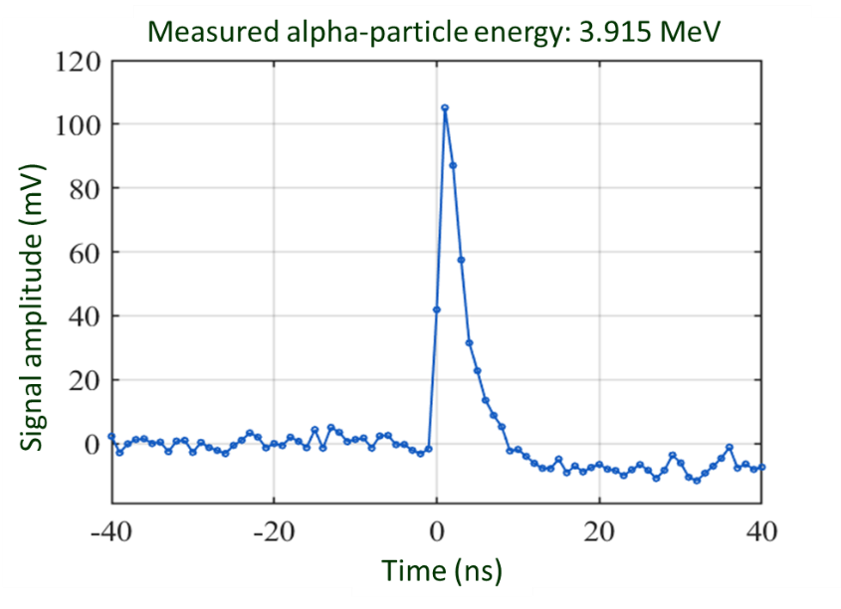
A Typical Alpha-Particle Signal Pulse from a SiC Sensor Detecting an Alpha with 3.915 MeV Energy
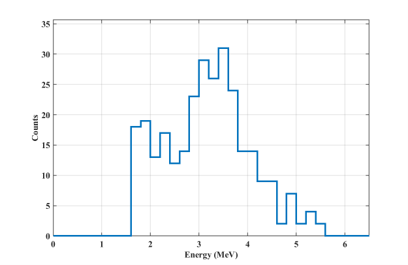
Alpha Particle Energy Spectrum Accumulated from the First 350 SiC Signals with a Total Sensor Area of 1.4 cm2, Equivalent to a Total Fusion Reaction Rate of over 108/s.
Experts from China and other countries reviewed these results, confirmed the validity of the fusion alpha data, and encouraged the ENN Fusion Team to rapidly address the next-level question of energetic ion acceleration that enables the fusion reaction in the first place, which has broader scientific significance for all magnetically confined p–¹¹B fusion.
ENN Fusion is pursuing a three-stage roadmap to commercialize proton–boron fusion.
Step 1: Demonstrate p–¹¹B fusion reactions by the end of 2026.
This milestone has now been achieved ahead of schedule on EXL-50U.
Step 2: Generate electricity from p–¹¹B fusion by 2030.
The next-generation spherical-torus EHL-2 (Helong-2) experimental platform to advance this objective is scheduled for completion by the end of 2027.
Step 3: Achieve steady-state, high-power electricity generation by 2035.
The goal is to advance toward a demonstration fusion power plant capable of sustained, high-power operation and to lay the groundwork for the commercial deployment of proton–boron fusion power.
UKAEA and ENN Fusion Conduct Joint Experiments under ITPEA on EXL-50U
2026-10-26ENN Fusion Achieves Experimental Demonstration of Proton–Boron Fusion on the EXL-50U Spherical Torus
2026-09-21Global Experts Gather in Langfang for ISPBF 2026
2026-07-24ENN Fusion Secures Pre-A Financing Round at RMB 10.6 Billion Post-Money Valuation
2026-07-13